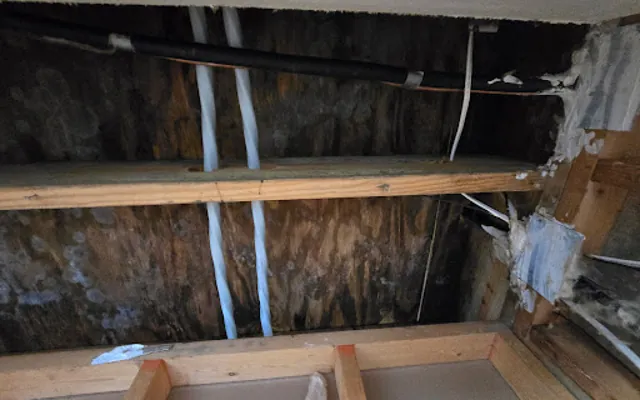
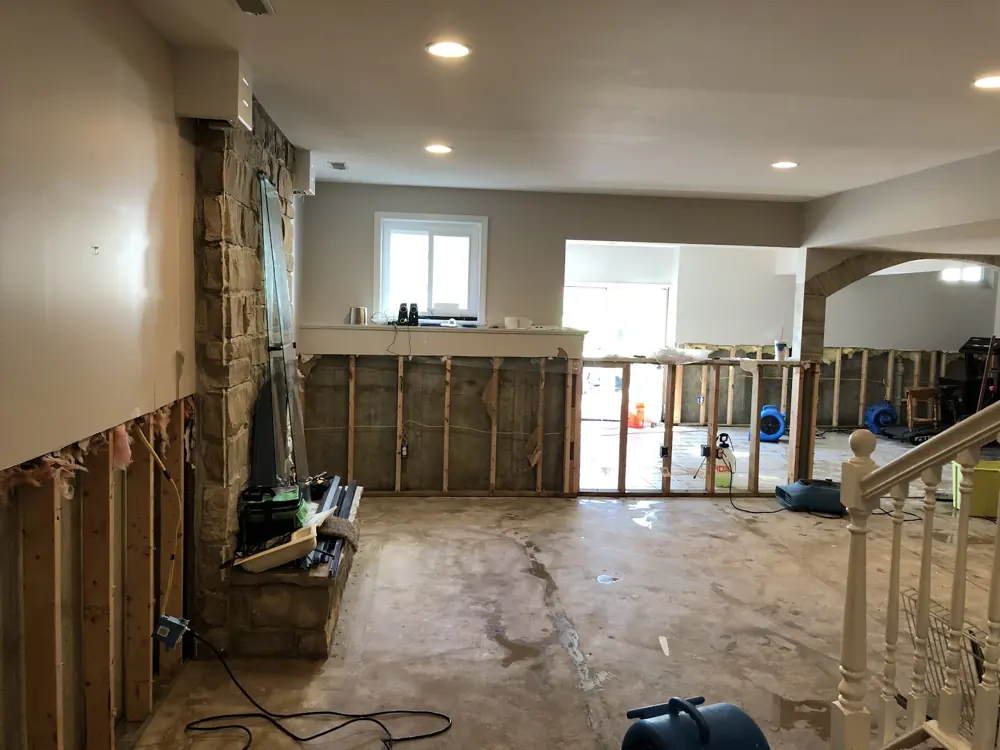
Ice dams are uncommon in the Piedmont, but a rare snow followed by a hard freeze can back water up under shingles and into the home. Local crews trace the entry, dry the structure, and stop the damage across Winston-Salem.

Technicians locate where the backed-up water entered, then use moisture meters and infrared to map how far it spread through the attic, ceilings, and wall cavities.
Saturated attic insulation is bagged and removed, and drywall wicking water along ceilings and walls is cut back to sound material so moisture is not sealed in.
Air movers and dehumidifiers dry the attic framing, ceilings, and wall cavities to a documented target, working the concealed spaces the water reached.
Moisture is rechecked until the structure reads dry, and the crew documents the readings and notes the roofing or insulation work a qualified contractor should complete.

While help is on the way, these first steps, done only where it is safe, limit the damage and protect the insurance claim.
Shut the supply off at the source, or close the home's main valve if the source is not obvious. Stopping the flow limits the damage more than anything else.
Switch off electricity to the affected area, but only if the breaker can be reached without standing in or touching the water.
Get a crew dispatched right away. The sooner extraction and drying begin, the more flooring, drywall, and belongings can be saved.
Take photos and a short video of the water and the affected rooms before anything is moved, so the insurance claim starts strong.
Ice dam water damage in Winston-Salem generally runs from about $1,500 to $7,000 on the rare occasion a dam forms. The main drivers are how much attic insulation and drywall are saturated, whether ceilings and walls are involved, and how far the water traveled. A small, quickly caught leak sits at the low end, while widespread attic and ceiling damage sits higher. The crew documents the moisture readings and photos to give the adjuster a documented record.
Crews reach Winston-Salem and Forsyth County fast, from Ardmore, the West End, and Old Salem to nearby Kernersville, Clemmons, Lewisville, Walkertown, and King. See the full list on the areas served across Winston-Salem page.
See all areas servedEvery loss is photographed, measured, and logged from the first visit, so the paperwork holds up with your insurance carrier.
Technicians follow recognized IICRC drying standards and prove the work with daily moisture readings, not guesswork.
Emergency dispatch any hour of the day or night, with a real crew on the way, not a callback in the morning.
A real crew dispatched any hour, not a callback in the morning.
Trained technicians following recognized IICRC drying standards.
Truck-mounted, portable, and submersible for any size loss.
The loss is documented and billed to the carrier directly.
They are uncommon here. The Piedmont usually has mild winters with little snow, so ice dams only form in the unusual season when a real snowfall is followed by a stretch of hard-freeze days. When those conditions do line up, homes built for moderate winters can be caught unprepared and take on water.
Heat escaping the roof melts the snow above, the meltwater refreezes into a ridge of ice at the cold eave, and water pools behind that dam. With no way to drain, it backs up under the shingles, passes through the roof deck, and enters the attic, ceilings, and walls like any roof leak.
Contain the dripping water with buckets and move belongings clear, and avoid climbing onto an icy roof yourself. Call for extraction and drying so the attic insulation and structure do not stay wet. A qualified roofer can address the roof and eave once the immediate leak is under control.
Sudden interior water damage from an ice dam is commonly covered under homeowners policies, though specifics vary. The crew documents the entry point, the conditions, and the moisture readings so the adjuster has clear support, and the carrier makes the final coverage decision.
Winston-Salem crews are on call 24 hours a day, local and fast, and can be on the way within the hour.
Call (336) 975-8145