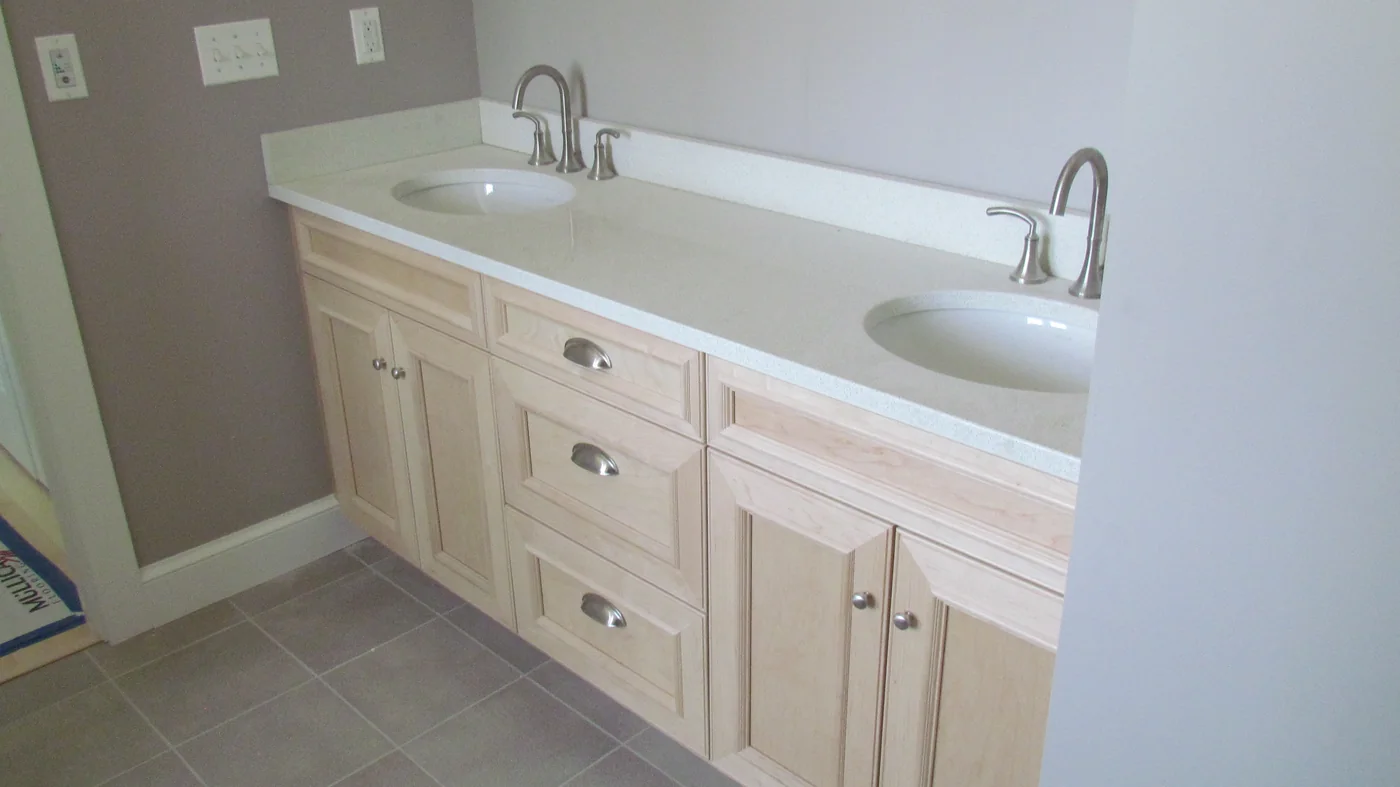
A blocked drain or a stuck stopper turns a bathroom sink into a slow flood that runs into the vanity, down to the subfloor, and often through to the room below. Local technicians extract the water and dry the cabinet and floor before it warps.

Technicians confirm the water is off, then check the counter, vanity interior, floor, and the ceiling below with moisture meters to map how far the overflow actually spread.
Water is pulled from the floor, the vanity base, and any pooled areas, and wet contents are removed from the cabinet so the interior can begin drying.
Air movers are directed into the open vanity and along the floor, with a dehumidifier controlling the small bathroom's humidity so trapped moisture in the toe-kick and subfloor is drawn out.
Moisture readings confirm the cabinet, floor, and any ceiling below have reached a dry target, and the crew documents the readings and photos for the record.

While help is on the way, these first steps, done only where it is safe, limit the damage and protect the insurance claim.
Shut the supply off at the source, or close the home's main valve if the source is not obvious. Stopping the flow limits the damage more than anything else.
Switch off electricity to the affected area, but only if the breaker can be reached without standing in or touching the water.
Get a crew dispatched right away. The sooner extraction and drying begin, the more flooring, drywall, and belongings can be saved.
Take photos and a short video of the water and the affected rooms before anything is moved, so the insurance claim starts strong.
A bathroom sink overflow in Winston-Salem usually runs from about $500 to $3,000. A quick catch with water confined to a tile floor sits at the low end, while a soaked vanity, wet subfloor, or a stained ceiling from a second-floor bathroom pushes the cost up. The main drivers are how long the water ran and how much cabinetry and structure it reached. The crew documents moisture readings and photos to support any insurance claim.
Crews reach Winston-Salem and Forsyth County fast, from Ardmore, the West End, and Old Salem to nearby Kernersville, Clemmons, Lewisville, Walkertown, and King. See the full list on the areas served across Winston-Salem page.
See all areas servedEvery loss is photographed, measured, and logged from the first visit, so the paperwork holds up with your insurance carrier.
Technicians follow recognized IICRC drying standards and prove the work with daily moisture readings, not guesswork.
Emergency dispatch any hour of the day or night, with a real crew on the way, not a callback in the morning.
A real crew dispatched any hour, not a callback in the morning.
Trained technicians following recognized IICRC drying standards.
Truck-mounted, portable, and submersible for any size loss.
The loss is documented and billed to the carrier directly.
Often yes, because the visible water on the floor is only part of it. Overflow soaks into the vanity base, runs under the toe-kick, and on an upper floor drips into the ceiling below. A quick moisture check and targeted drying prevents swollen cabinets and hidden mold that a towel cannot reach.
Not always. If the water is caught quickly and the cabinet is solid wood or plywood, drying often saves it. Particleboard bases swell once saturated and may need replacement. Technicians check the moisture content and dry the cabinet in place whenever it can be salvaged.
For water confined to a bathroom, drying usually runs one to three days depending on how far it spread and whether a ceiling below is involved. Air movers and a dehumidifier run continuously, and the crew rechecks moisture until the cabinet, floor, and subfloor read dry.
A sudden accidental overflow is commonly covered by homeowners policies, while damage from a slow, long-ignored drip may not be. The crew documents the cause and the moisture readings so the adjuster has support, and the coverage decision rests with the carrier.
Winston-Salem crews are on call 24 hours a day, local and fast, and can be on the way within the hour.
Call (336) 975-8145