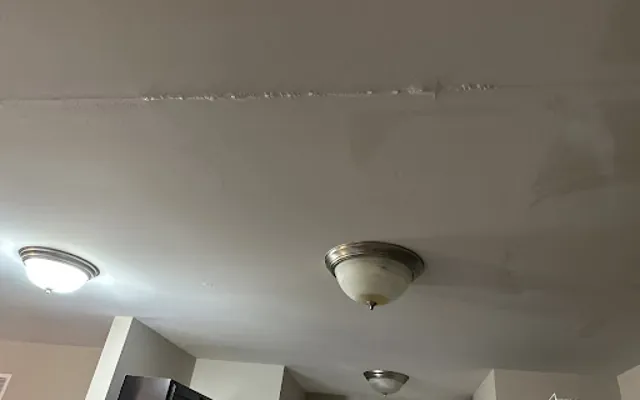
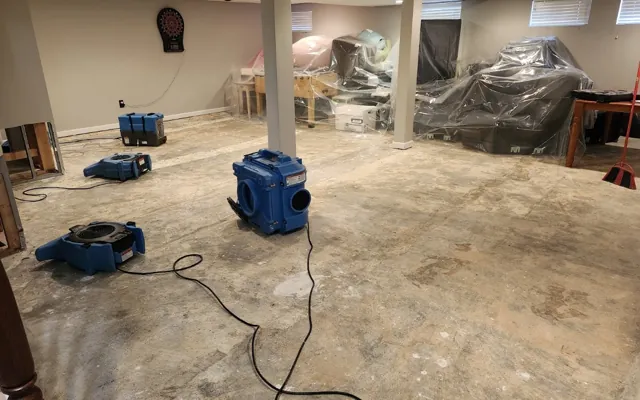
Washington Park, NC: Local crews respond fast to a bulging or stained ceiling, following IICRC-standard methods to relieve pooled water, dry the cavity, and document the work for Washington Park homeowners.

Technicians first inspect the roof, second-floor plumbing, and the crawlspace below a Washington Park home. They use moisture meters and infrared cameras to pinpoint exactly where water entered and how far it has spread in the ceiling.
A sagging ceiling holds dangerous weight. The crew makes a small, controlled opening to drain pooled water safely. This prevents a sudden collapse and allows the saturated drywall and insulation to begin the drying process.
Using air movers and industrial dehumidifiers, the team dries the ceiling cavity from both sides where access allows. They work to a documented moisture target, ensuring the hidden wood framing and insulation are dry, not just the surface.

Ceiling water damage in Washington Park generally runs from about $1,000 to $5,000. Cost depends on how much drywall is saturated, whether insulation and framing above are wet, and how difficult the source is to reach. A small stain caught early sits at the low end, while a sagging ceiling that must be opened and rebuilt sits higher. The crew documents the source, moisture readings, and photos so the carrier has clear support.
In Washington Park, NC, the neighborhood's classic bungalows and foursquares, built from the 1910s to the 1930s, have low ground near Salem Creek. This means a heavy thunderstorm can push runoff toward foundations, creating a path for water to enter and soak a ceiling. A bulge or stain overhead demands a fast look. Washington Park's older housing stock sits on rolling, red-clay soil near a creek. During intense storms, runoff can pool around foundations and find its way into vulnerable crawlspaces, leading to water tracking up into ceiling cavities from below or from compromised roofs above. From Washington Park, crews also cover nearby Boston-Thurmond, Kimberley Park, Old Salem, Fairview, West Salem, Happy Hill. See every neighborhood and town on the full service area page.
See all areas servedEvery loss is photographed, measured, and logged from the first visit, so the paperwork holds up with your insurance carrier.
Technicians follow recognized IICRC drying standards and prove the work with daily moisture readings, not guesswork.
Emergency dispatch any hour of the day or night, with a real crew on the way, not a callback in the morning.
A real crew dispatched any hour, not a callback in the morning.
Trained technicians following recognized IICRC drying standards.
Truck-mounted, portable, and submersible for any size loss.
The loss is documented and billed to the carrier directly.
Common sources include aging roof materials on historic homes, plumbing from a second-floor bathroom, and stormwater intrusion from the low-lying areas near Salem Creek. Local crews inspect all potential paths to find the exact point of entry.
Drying a ceiling cavity in Washington Park's humid climate typically takes two to four days with professional equipment. The timeframe depends on the extent of saturation and whether both sides of the ceiling assembly can be accessed for drying.
Crews are on call 24 hours a day and can be on the way to Washington Park within the hour.
Call (336) 975-8145