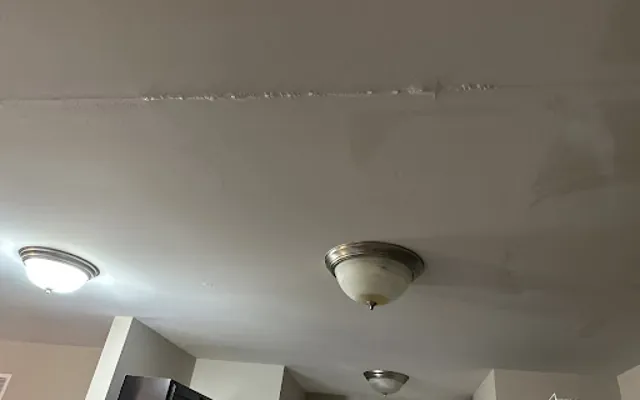
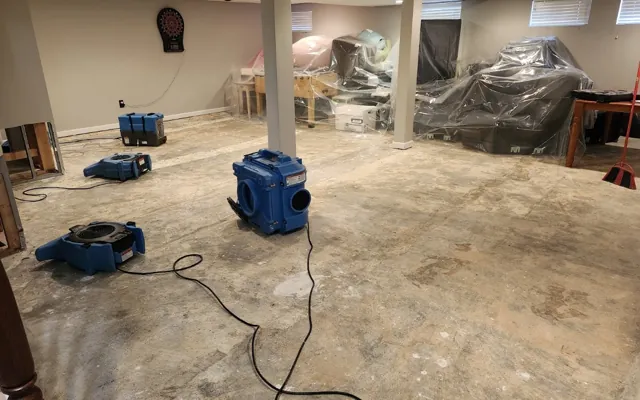
For Advance, NC homes, a sagging or stained ceiling can be a sign of hidden water. Local crews respond fast to relieve the weight, dry the structure from both sides, and follow IICRC-standard methods to restore safety.

Technicians first find where water is entering, checking the roof, upstairs plumbing, and crawlspace areas. They use moisture meters to map the full spread of saturation within the ceiling assembly.
To prevent a dangerous collapse, the crew carefully relieves the pooled water from a bulging ceiling. This controlled release lets the cavity drain and marks the start of the drying process.
Air movers and dehumidifiers dry the wet drywall, insulation, and framing from both sides where possible. The team monitors moisture until the assembly meets a specific, documented dry target.

Ceiling water damage in Advance generally runs from about $1,000 to $5,000. Cost depends on how much drywall is saturated, whether insulation and framing above are wet, and how difficult the source is to reach. A small stain caught early sits at the low end, while a sagging ceiling that must be opened and rebuilt sits higher. The crew documents the source, moisture readings, and photos so the carrier has clear support.
In Advance, NC, rural homes on large lots with well-and-septic plumbing mean a ceiling leak can start upstairs or in a crawlspace and go unnoticed for weeks. The first sign is often a stain or bulge, but the water damage inside the ceiling cavity may be much more extensive. Older homesteads and custom homes in Advance, NC, often have plumbing runs through attics and crawlspaces. A slow leak from a pipe or a roof issue can soak insulation and framing over time, especially with the area's humid subtropical climate. From Advance, crews also cover nearby King, Oak Ridge, Tobaccoville, Welcome, Bermuda Run, Colfax. See every neighborhood and town on the full service area page.
See all areas servedEvery loss is photographed, measured, and logged from the first visit, so the paperwork holds up with your insurance carrier.
Technicians follow recognized IICRC drying standards and prove the work with daily moisture readings, not guesswork.
Emergency dispatch any hour of the day or night, with a real crew on the way, not a callback in the morning.
A real crew dispatched any hour, not a callback in the morning.
Trained technicians following recognized IICRC drying standards.
Truck-mounted, portable, and submersible for any size loss.
The loss is documented and billed to the carrier directly.
Drying times depend on how much water entered and the materials involved. For a typical ceiling leak in an Advance home, the active drying phase with equipment often takes two to four days, followed by verification to ensure the structure is truly dry.
Technicians prefer to dry from both sides when access allows, which often means opening a small section in an Advance home's ceiling or working from a crawlspace below. This ensures the insulation and wood framing dry completely, preventing mold.
Crews are on call 24 hours a day and can be on the way to Advance within the hour.
Call (336) 975-8145