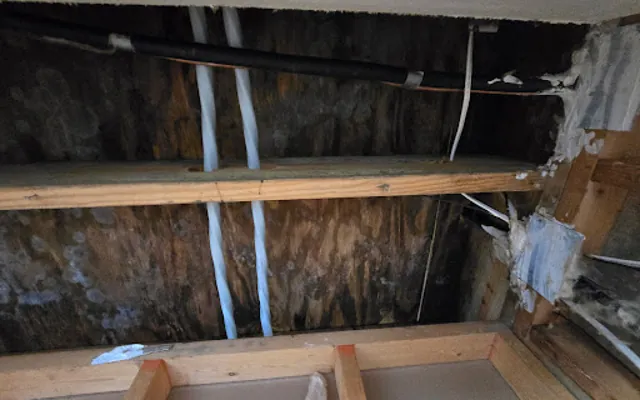
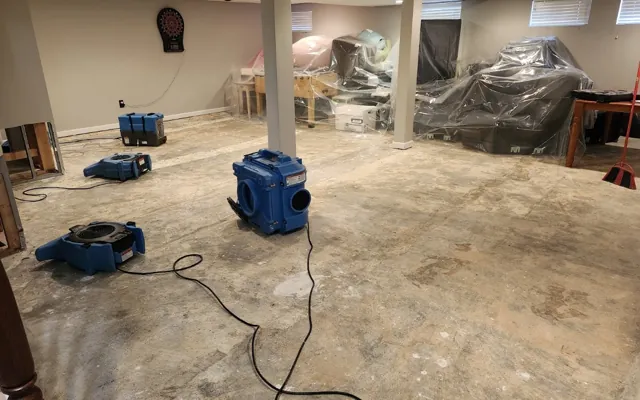
For Washington Park, NC residents, a rapid response to attic water damage helps save the older framing in historic bungalows. Local crews follow IICRC-standard methods to pump, extract, and manage precise drying after heavy storms.

Technicians inspect the roof deck and vents from inside the attic. They use infrared cameras and moisture meters to see exactly how far water has traveled into insulation, rafters, and the ceiling drywall below in Washington Park homes.
Wet insulation holds moisture against the framing for days. The crew bags and removes all soaked batts and cuts back any ceiling drywall that is wicking water, preserving as much original material as possible.
Air movers and dehumidifiers are staged in the attic and rooms below. They dry the sheathing, rafters, and top plates to a specific moisture target, which is documented, rather than relying on a surface-level guess.

Attic water damage in Washington Park generally runs from about $1,500 to $6,000. The main drivers are how much insulation must be removed, whether ceiling drywall below is affected, and how far water tracked into the framing. A small, quickly caught leak sits at the low end, while a saturated attic with ceiling damage runs higher. The crew documents moisture readings and photos so the carrier has clear support for a sudden-loss claim.
In Washington Park, the low ground near Salem Creek can send storm runoff toward foundations and crawlspaces of the neighborhood's historic bungalows. When heavy rain or a roof leak sends water upward, it soaks insulation and can travel along ceiling lines, threatening the older wood framing and plaster common in these homes. Heavy thunderstorms in the Piedmont Triad push runoff toward the low-lying areas of Washington Park. Water can pool near foundations and enter crawlspaces, while older roofs on historic homes are susceptible to leaks that channel water into the attic space. From Washington Park, crews also cover nearby Boston-Thurmond, Kimberley Park, Old Salem, Fairview, West Salem, Happy Hill. See every neighborhood and town on the full service area page.
See all areas servedEvery loss is photographed, measured, and logged from the first visit, so the paperwork holds up with your insurance carrier.
Technicians follow recognized IICRC drying standards and prove the work with daily moisture readings, not guesswork.
Emergency dispatch any hour of the day or night, with a real crew on the way, not a callback in the morning.
A real crew dispatched any hour, not a callback in the morning.
Trained technicians following recognized IICRC drying standards.
Truck-mounted, portable, and submersible for any size loss.
The loss is documented and billed to the carrier directly.
Drying times depend on the extent of saturation and the weather. For a typical job in the area, with professional equipment placed in the attic and rooms below, the active drying phase often takes two to four days. Crews take moisture readings daily until the framing meets the dry standard.
Most homeowner policies in NC cover sudden, accidental water damage, like that from a storm. A key factor is documenting the source and extent with moisture readings and photos, which local crews provide. Slow leaks from long-term neglect are typically not covered, so a prompt call is advised.
Crews are on call 24 hours a day and can be on the way to Washington Park within the hour.
Call (336) 975-8145